How Prefabrication Is Reshaping Healthcare Construction
Healthcare CFOs and facilities leaders are navigating a difficult reality: critical projects remain necessary, but available capital continues to tighten.
Hospitals and health systems across the country are facing mounting financial pressure from rising labor costs, Medicare and Medicaid reimbursement challenges, and a backlog of infrastructure projects deferred during the COVID-19 pandemic. Expansion plans are being reevaluated, aging systems remain in service longer than intended, and capital committees are scrutinizing project ROI more closely than ever before.
In many cases, the conversation centers around what can be delayed or reduced. However, one of the most impactful opportunities often receives less attention: how projects are delivered.
The construction delivery method itself, specifically the balance between off-site fabrication and on-site installation, can have a direct and measurable impact on project cost, schedule, safety, and operational disruption. This is where prefabrication is proving to be a strategic advantage for healthcare systems working within increasingly constrained capital environments.
The benefits are significant. Prefabrication can reduce project timelines by 20% or more, accelerating occupancy and revenue generation for new or upgraded service lines. It can also reduce on-site labor requirements by up to 40%, helping address one of the industry’s largest cost drivers. Beyond the financial benefits, fewer workers operating within active healthcare environments means reduced infection control risk, less disruption to patients and staff, and lower administrative burden for facility teams.
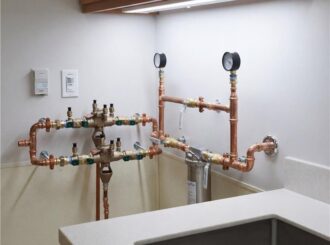
At A/Z Corporation, we have been investing in prefabrication and modular delivery capabilities for more than a decade. Since 2013, our Hopkinton, Rhode Island fabrication and logistics facility, including its ISO 8 clean fabrication space, has supported healthcare and life sciences clients across New England through the fabrication of utility and medical gas piping, mechanical systems, skids, and modular assemblies.
That capability becomes especially valuable in active clinical environments where schedule certainty and operational continuity are critical.
For example, when Yale New Haven Health required replacement of a cooling tower located above a primary hospital entrance and connected to critical systems, including MRI operations, our team self-performed the civil, mechanical, and electrical scope while coordinating all major lifts during off-hours. A temporary 200-ton chiller remained operational throughout construction, allowing the hospital to maintain uninterrupted patient care.
Similarly, when a hospital in Salem, Massachusetts required a complete single-cycle CHP module installation, our team managed design integration, fabricated the modular package at our Hopkinton facility, and delivered it to the site in four sections for streamlined assembly. Fabricating the system in a controlled environment improved quality control, compressed the overall project schedule, and significantly reduced field labor requirements.
Today’s healthcare capital environment leaves little room for costly change orders, prolonged schedules, or operational disruption. Every decision, from scope prioritization to delivery strategy, has a greater impact on financial performance and patient operations than ever before.
For healthcare organizations planning infrastructure upgrades, MEP improvements, or facility modernization projects within active clinical environments, prefabrication offers more than speed alone. It offers predictability, efficiency, and a smarter approach to delivering complex projects under challenging conditions.